
... The instruction also noted that the reported appearance of Jesus had said the world would end before the year 2000. “Clearly, this purported prophecy was not fulfilled,” it said.
Um . . .
I am coming soon.
-- Revelation 3:11; 22:7, 12, 20
... The instruction also noted that the reported appearance of Jesus had said the world would end before the year 2000. “Clearly, this purported prophecy was not fulfilled,” it said.
Um . . .
I am coming soon.
-- Revelation 3:11; 22:7, 12, 20


The French media regulator has fined the conservative channel CNews €100,000 for, during a Catholic programme, saying that abortion is the world’s leading cause of death. The episode reveals the extent to which the debate on abortion is deadlocked in France.
In February 2024, presenter Aymeric Pourbaix, during the Catholic programme “En quête d’esprit,” broadcast every Sunday on the conservative channel CNews, showed an infographic on the causes of death, ranking abortion as the leading cause, with 73 million deaths each year worldwide. That translates to 52% of annual deaths, far ahead of cancer (10 million) and smoking (6.2 million).
The journalist’s comments sparked a wave of indignation in the
mainstream press, on the grounds that abortion cannot be considered a
“cause of death” because the foetus should not be considered a living
being. ...
Reported here.
See current year for yourself under Health.
In a paper presented at a recent meeting of the European Society for Human Evolution, researchers point to 25,000-year-old paintings in France and Spain that depict silhouettes of hands. On more than 200 of these prints, the hands lack at least one digit. In some cases, only a single upper segment is missing; in others, several fingers are gone. ... Four sites in Africa, three in Australia, nine in North America, five in south Asia and one in south-east Asia contain evidence of finger amputation. “This form of self-mutilation has been practised by groups from all inhabited continents,” said Collard. “More to the point, it is still carried out today, as we can see in the behaviour of people like the Dani.”
More.

The Christian gospel accounts have been dismissed perennially as mere hyperbole:
And if thy right eye offend thee, pluck it out, and cast it from thee: for it is profitable for thee that one of thy members should perish, and not that thy whole body should be cast into hell. And if thy right hand offend thee, cut it off, and cast it from thee: for it is profitable for thee that one of thy members should perish, and not that thy whole body should be cast into hell.
-- Matthew 5:29f.
Wherefore if thy hand or thy foot offend thee, cut them off, and cast them from thee: it is better for thee to enter into life halt or maimed, rather than having two hands or two feet to be cast into everlasting fire. And if thine eye offend thee, pluck it out, and cast it from thee: it is better for thee to enter into life with one eye, rather than having two eyes to be cast into hell fire.
-- Matthew 18:8f.
And if thy hand offend thee, cut it off: it is better for thee to enter into life maimed, than having two hands to go into hell, into the fire that never shall be quenched:
Where their worm dieth not, and the fire is not quenched.
And if thy foot offend thee, cut it off: it is better for thee to enter halt into life, than having two feet to be cast into hell, into the fire that never shall be quenched:
Where their worm dieth not, and the fire is not quenched.
And if thine eye offend thee, pluck it out: it is better for thee to enter into the kingdom of God with one eye, than having two eyes to be cast into hell fire:
Where their worm dieth not, and the fire is not quenched.
-- Mark 9:43ff.
This older tradition is remembered in stark contrast to the miracle working Jesus of resurrection imagination who is wont to undo some of these extreme expressions of repentance:
The blind receive their sight, and the lame walk, the lepers are cleansed, and the deaf hear, the dead are raised up, and the poor have the gospel preached to them.
-- Matthew 11:5
And great multitudes came unto him, having with them those that were lame, blind, dumb, maimed, and many others, and cast them down at Jesus' feet; and he healed them: Insomuch that the multitude wondered, when they saw the dumb to speak, the maimed to be whole, the lame to walk, and the blind to see: and they glorified the God of Israel.
-- Matthew 15:30f.
And the blind and the lame came to him in the temple; and he healed them.
-- Matthew 21:14
And in that same hour he cured many of their infirmities and plagues, and of evil spirits; and unto many that were blind he gave sight. Then Jesus answering said unto them, Go your way, and tell John what things ye have seen and heard; how that the blind see, the lame walk, the lepers are cleansed, the deaf hear, the dead are raised, to the poor the gospel is preached.
-- Luke 7:21f.
This is how it works. It's about credentialism and arguments from authority, not about "science". Academia is rife with this sort of thing. Today's academics are as phony as the medieval clerisy ever was.
... four of the five authors said they played no part in collecting the data for the test in question.
That leaves Ariely, who confirmed that he alone was in touch with the insurance company that ran the test with its customers and provided him with the data. But he insisted that he was innocent, implying it was the company that was responsible. ...
Francesca Gino, a Harvard Business School professor and one of the authors, wrote, “I was not involved in conversations with the insurance company that conducted the field experiment, nor in any of the steps of running it or analyzing the data.”
Another author, Nina Mazar, then at the University of Toronto and now a marketing professor at Boston University, told the blog, “I want to make clear that I was not involved in conducting the field study, had no interactions with the insurance company, and don’t know when, how, or by whom exactly the data was collected and entered. I have no knowledge of who fabricated the data.”
Gino declined to be interviewed for this story, and Mazar did not return a request for comment. ...
Bazerman of Harvard ... had questions about the insurance experiment’s seemingly “implausible data.” A coauthor assured him the data were accurate and another showed him the file, though he admitted that he did not personally examine it. When the 2012 paper made waves, he “then believed the core result” and taught it to students and corporate executives alike. In retrospect, he wrote, “I wish I had worked harder to identify the data were fraudulent, to ensure rigorous research in a collaborative context, and to promptly retract the 2012 paper.”
Shu, another coauthor who now works in venture capital, voiced similar regrets on Twitter this week. “We began our collaboration from a place of assumed trust — rather than earned trust,” she wrote. “Lesson learned.” She declined to comment for this story.


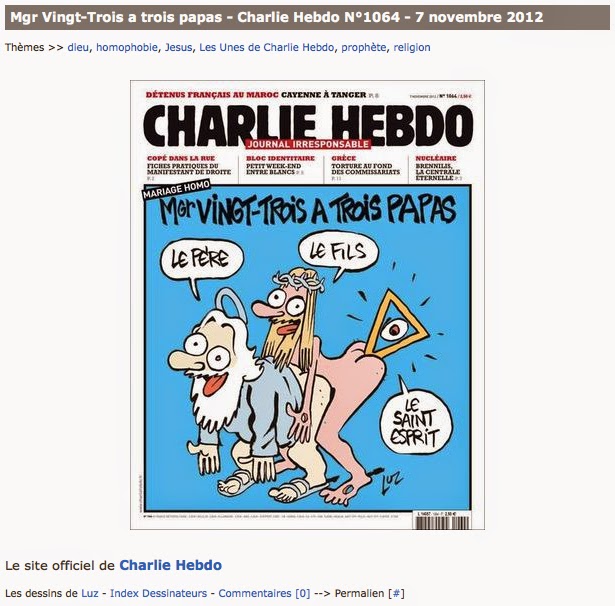 |
| The Holy Trinity by Charlie Hebdo's Luz |


