Showing posts with label Thomas Paine. Show all posts

Wednesday, April 8, 2026

Thomas Paine grasped that Christianity implied the suicide of God long before the God is Dead theologians of the 1960s came along

Somewhere in Texas, out of which nothing good comes

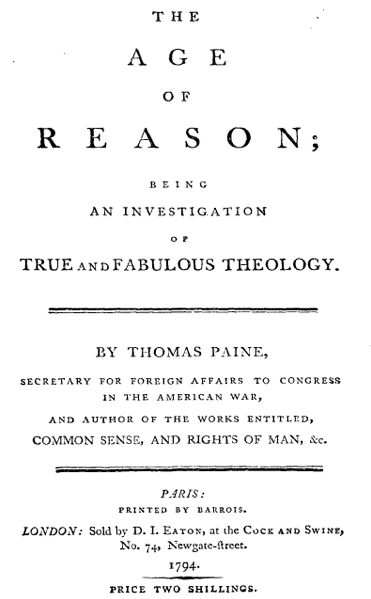
... A man is preached instead of a God; an execution is an object for gratitude; the preachers daub themselves with the blood, like a troop of assassins, and pretend to admire the brilliancy it gives them; they preach a humdrum sermon on the merits of the execution; then praise Jesus Christ for being executed, and condemn the Jews for doing it. ...   So many wild and blasphemous conceits have been formed of the Almighty. The Jews have made him the assassin of the human species, to make room for the religion of the Jews. The Christians have made him the murderer of himself, and the founder of a new religion to supersede and expel the Jewish religion. And to find pretence and admission for these things, they must have supposed his power or his wisdom imperfect, or his will changeable ...

-- Thomas Paine, Age of Reason

Tuesday, April 7, 2026

Thomas Paine on the fanatical character of Paul


 The character of the person called Paul, according to the accounts given of him, has in it a great deal of violence and fanaticism; he had persecuted with as much heat as he preached afterwards; the stroke he had received had changed his thinking, without altering his constitution; and either as a Jew or a Christian he was the same zealot. Such men are never good moral evidences of any doctrine they preach. They are always in extremes, as well of action as of belief.

-- Thomas Paine, Age of Reason

Wednesday, December 3, 2025

Thomas Paine: Isaiah did not predict the virgin birth of Jesus


 ... Behold a virgin shall conceive, and bear a son (Isa. vii. 14), has been interpreted to mean the person called Jesus Christ, and his mother Mary, and has been echoed through christendom for more than a thousand years. ...

Whether Isaiah was playing a trick with Ahaz, king of Judah, to whom this passage is spoken, is no business of mine; I mean only to show the misapplication of the passage, and that it has no more reference to Christ and his mother, than it has to me and my mother. The story is simply this:

The king of Syria and the king of Israel (I have already mentioned that the Jews were split into two nations, one of which was called Judah, the capital of which was Jerusalem, and the other Israel) made war jointly against Ahaz, king of Judah, and marched their armies towards Jerusalem. Ahaz and his people became alarmed, and the account says (Is. vii. 2), Their hearts were moved as the trees of the wood are moved with the wind.

In this situation of things, Isaiah addresses himself to Ahaz, and assures him in the name of the Lord (the cant phrase of all the prophets) that these two kings should not succeed against him; and to satisfy Ahaz that this should be the case, tells him to ask a sign. This, the account says, Ahaz declined doing; giving as a reason that he would not tempt the Lord; upon which Isaiah, who is the speaker, says, ver. 14, “Therefore the Lord himself shall give you a sign; behold a virgin shall conceive and bear a son;” and the 16th verse says, “And before this child shall know to refuse the evil, and choose the good, the land which thou abhorrest or dreadest [meaning Syria and the kingdom of Israel] shall be forsaken of both her kings.” Here then was the sign, and the time limited for the completion of the assurance or promise; namely, before this child shall know to refuse the evil and choose the good.

Isaiah having committed himself thus far, it became necessary to him, in order to avoid the imputation of being a false prophet, and the consequences thereof, to take measures to make this sign appear. It certainly was not a difficult thing, in any time of the world, to find a girl with child, or to make her so; and perhaps Isaiah knew of one beforehand; for I do not suppose that the prophets of that day were any more to be trusted than the priests of this: be that, however, as it may, he says in the next chapter, ver. 2, “And I took unto me faithful witnesses to record, Uriah the priest, and Zechariah the son of Jeberechiah, and I went unto the prophetess, and she conceived and bare a son.”

Here then is the whole story, foolish as it is, of this child and this virgin; and it is upon the barefaced perversion of this story that the book of Matthew, and the impudence and sordid interest of priests in later times, have founded a theory, which they call the gospel; and have applied this story to signify the person they call Jesus Christ; begotten, they say, by a ghost, whom they call holy, on the body of a woman engaged in marriage, and afterwards married, whom they call a virgin, seven hundred years after this foolish story was told; a theory which, speaking for myself, I hesitate not to believe, and to say, is as fabulous and as false as God is true.

But to show the imposition and falsehood of Isaiah we have only to attend to the sequel of this story; which, though it is passed over in silence in the book of Isaiah, is related in 2 Chronicles, xxviii; and which is, that instead of these two kings failing in their attempt against Ahaz, king of Judah, as Isaiah had pretended to foretel in the name of the Lord, they succeeded: Ahaz was defeated and destroyed; an hundred and twenty thousand of his people were slaughtered; Jerusalem was plundered, and two hundred thousand women and sons and daughters carried into captivity. Thus much for this lying prophet and imposter Isaiah, and the book of falsehoods that bears his name. ...

-- Thomas Paine, The Age of Reason 


Tuesday, December 2, 2025

Thomas Paine doubted the historicity of The Slaughter of the Innocents because John the Baptist survived it without fleeing to escape it


 ... This writer [Matthew] tell us, that Jesus escaped this slaughter, because Joseph and Mary were warned by an angel to flee with him into Egypt; but he forgot to make provision for John [the Baptist], who was then under two years of age. John, however, who staid behind, fared as well as Jesus, who fled; and therefore the story circumstantially belies itself. ...

-- Thomas Paine, The Age of Reason 

Monday, December 1, 2025

By this standard Jesus was a false prophet because the world didn't end, but so was Moses because no prophet like himself arose to lead Israel


 When a prophet speaketh in the name of the LORD, if the thing follow not, nor come to pass, that is the thing which the LORD hath not spoken, but the prophet hath spoken it presumptuously: thou shalt not be afraid of him.

--  Deuteronomy 18:22

Sunday, May 19, 2024

A long name signifying imminent and utter despoilation times two requires a big boy pen and a big boy piece of paper

Tiglath-Pileser III subjugated the Northern Kingdom of Israel in 732 BC


 Moreover the LORD said unto me, Take thee a great roll, and write in it with a man's pen concerning Mahershalal-hashbaz. And I took unto me faithful witnesses to record, Uriah the priest, and Zechariah the son of Jeberechiah. And I went unto the prophetess; and she conceived, and bare a son. Then said the LORD to me, Call his name Mahershalalhashbaz. For before the child shall have knowledge to cry, My father, and my mother, the riches of Damascus and the spoil of Samaria shall be taken away before the king of Assyria.

-- Isaiah 8:1ff.

Friday, July 21, 2023

Book reviewer in the self-loathing Christianity Today doesn't mention how Paine had to delay publishing part of his work in America because he was so hated

Early Americans Read the Bible in a Way That Nearly Destroyed America :

As Mark Noll explains in America’s Book: The Rise and Decline of a Bible Civilization, 1794–1911, figures like Paine were instrumental in shaping America’s commitment to independence, which in turned shaped how its people engaged the Bible. In Paine’s mind, and in the minds of many of his contemporaries, Americans had the right to use the Bible however they saw fit, lest they bite the hand—independence—that fed them their freedom.

Yeah, that's why only six people came to Paine's funeral in 1809.

There is hardly a figure from America's revolutionary period who equaled Paine's fall from the heights of influence to the depths of ignominy.

The Paine revival in America came later, on the heels of Darwin's The Origin of Species in 1859.


Thursday, March 26, 2015

Moses and the American founders

From James P. Byrd, here:

[T]he story of Moses and the Exodus was one of the most cited biblical texts in revolutionary America. In 1776, John Adams wrote to his wife, Abigail, about “a Parallel between the Case of Israel and that of America.” John Adams had heard this preached in a sermon, and he thought it was enlightening because it “indicated strongly the Design of Providence that We should be separated from G. Britain.” ...

In 1776, when Benjamin Franklin and Thomas Jefferson discussed what should be on a “Great Seal” for the new nation, they both thought of the Exodus story. As John Adams reported, Franklin wanted the seal to feature the parting of the Red Sea, with Moses raising his staff while Pharaoh and his chariots of soldiers drowned as the waters closed in on them. In contrast, Jefferson wanted another scene from the Exodus, with the Israelites led through the wilderness by a cloud in daytime and a pillar if fire at night.

Some of the founders saw themselves as politically enslaved by the British “pharaoh,” King George III, and his oppressive policies. ... [M]any patriots adopted this story, viewing themselves as the new Israel, and naming George Washington the American Moses. ... 


[Thomas Paine] turned to 1 Samuel 8 to make his case. Paine asserted that God did not want the people to have a king. God warned that kings would oppress them, and so they did, Paine argued.